Sunday, 23 February 2025

PREDATORY ENCOUNTERS - IMPROVING THE RANDOM ENCOUNTER

PREDATORY ENCOUNTERS - IMPROVING THE ENCOUNTER DIE WITH TENSION, STEALTH & DUNGEON REACTIVITY, OR - A SIMPLE UNDERCLOCK ALTERNATIVE

Do you want encounters to occur more regularly?  

Do you want the dungeon to respond to your players' foolishness?  

Do you want your players to feel hunted and pursued?

Try the Predatory Encounter Die!*

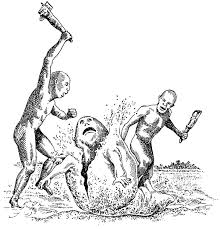
The dungeon has found them - all art is from Down in the Dungeon, 1981

Standard Encounter Rolls

At its most basic level, the typical encounter roll looks like this:  

"Every 10 minutes, roll 1d6. On a 1, a random encounter occurs."  


Overloaded Encounter Rolls
A sagely fellow (Necropraxis I believe) once asked “what about the other numbers?”. Overloaded Encounter rolls largely function the same as Standard Encounter rolls, save that there are results for rolls of 2-6. Meaning that rolling is always meaningful. These results typically include things such as light source depletion, a description of the environment or signs/spoors/omens/clues that hint at nearby wandering monsters. Everyone has their own formula for a good Overloaded Encounter die. Until I share mine, find some here, here and here (but there are many more). BUT, some still felt this roll was lacking - ‘is 1-in-6 frequent enough?’ or ‘this is fun, but still feels static’. I know I have certainly run dungeon sessions and one-shots where due to the whims of the dice, there have been no actual encounters. Many have tried to fix this, which leads us to…


The Underclock
Somewhat recently, Arnold K of Goblin Punch tackled this problem by introducing The Underclock which is essentially a countdown to a guaranteed encounter. The Underclock does a few things, it is meant to ensure an encounter, suggest that the dungeon is responding to the actions of the players and create a sense of tension, a feeling of pursuit. However, in practice, (I have played in games with the Underclock) it introduces too much predictability  - players feel safe when the Underclock is high, plus it's just that bit fiddlier than rolling a die. But what if there was…


Another Way - The PREDATORY ENCOUNTER DIE
What if we could combine the variated, meaningful results of the Overloaded Encounter Die, the tension of The Underclock and ensure encounter frequency in a simple manner? That's this method. The standard encounter roll becomes a measure of the dungeon’s awareness as it shifts and searches for the players. It's very simple, surely done before, but, this is it:

They are hunted
How It Works
1. Start with a d6 (this is your Encounter Die) as standard.  
2. Roll it whenever you would normally check for encounters, every ten minutes, every three rooms, etc.
3. If the result is 6 (or higher), an encounter occurs. 
4. Results of 2-5 trigger standard Overloaded Encounter effects (light depletion, environmental signs, etc.) according to your taste. In addition to any effect on rolls 2-5, the encounter die increases in size (d8 → d10 → d12 → d20) as the dungeon hones in on the party. When you next roll for encounters, do so with the new die size. Encounters continue to occur on a 6 or higher. The probability grows - the monsters are getting nearer!
5. A result of 1, lowers the Predatory Encounter Die size by one increment. 
6. Importantly, the Predatory Encounter die also increases in size whenever player characters make loud noises, allow intelligent/organised enemies to escape or otherwise draw attention to themselves.
7. Once an encounter does occur and is resolved (or the party leave the dungeon), the encounter die resets back to d6. However, the minimum encounter die size can increase if the dungeon becomes particularly alert.  
8. Hiding successfully for 10 minutes (which still requires an encounter roll as time passes) can reduce the encounter die back to a d6. 

Encounter Probability by Die Size

Die Size_____Encounter Chance

d6__________16.67% 

d8__________37.5% 

d10_________50% 

d12_________58.33%  (weird!)

d20_________75% 

It works! The probability is weird and lumpy but your players will get it, big = bad. This method is meant to be player-facing. Let your players see the die grow, make them roll it. Having it out on the table will give rise to tension and be a constant reminder that something is looking for them and that it is getting closer. However, if the encounter rate seems too high, check out the alternate method below.

The dungeon takes its prisoners

Tips, Adjustments and Options

  • A roll of 1 on the encounter die can represent a lull or lapse in alertness and lowers the die size by one.
  • What constitutes a rise in the encounter die? You know already, explosions, throwing skeletons down wells, kicking down doors, any kind of demolition/destruction, if intelligent enemies are able and allowed to report the party’s location, and depending on your setting and opinion - the use of firearms. Anything that feels like it should increase the dungeon’s alertness levels - should.
  • If needed, use a small tracker to help keep on top of the encounter die, all that would be needed is 5 boxes, labelled d6 through to d20 and a bead to place on the current encounter die size. Let the players see this.
  • When hiding, players should think about how and where they are hiding and describe it as they would any other action, such as with inspecting and disarming traps for instance. If your system has a stealth skill, that can be used only if an encounter is rolled while the party is hidden. On a successful stealth roll, reroll the encounter die or bypass the encounter - it's up to you. Their description and hiding place may give them a bonus or malus to the roll. It might be so good they don’t even need to roll!  This will increase that particular feeling of stealth in your games and allow for scenes I’d never or very rarely seen before - the DM describing the party hiding while a monster walks past them. I can see the various rolls, results and DM description in this classic LotR scene.
  • This is optional; If players severely disrupt the dungeon, increase the minimum die size (e.g. it defaults to a d8 instead of d6). Perhaps if the party steals the all-important Blue Jewel or the Dragon’s egg, slay the High-Priest, get sprayed with stinking monster-bait, stab the dungeon’s beating heart, insult the Goblin Queen. Any dramatic event might qualify and reducing the minimum die size would be bespoke to whatever caused its rise.
  • Generous DMs can offer a reprieve by temporarily using a d4 encounter die that cannot trigger encounters.
  • Predatory Encounters are tougher than regular encounter mechanics, this is ok. It will make your players tougher in kind.
The Alternate Method
  • However, to reduce the encounter rate, consider this - remove the out of turn and automatic increases to the encounter die. Instead, during a 10 minute turn, ask yourself as the DM, 'do the player's actions warrant an increase in the size of encounter die?' if yes, increase the die size, if not keep the encounter die size and roll as normal. There are no automatic increases with this method, instead you would immediately roll for encounters with the current die size whenever the party do anything that might draw attention to themselves. Otherwise, the mechanic remains the same.

Why Use this Rule?

This slight change for rolling for encounters retains meaning with every roll, creates tension, meaningful choices and gives the dungeon another avenue to feel like a living thing.
- It maintains traditional encounter mechanics while adding a rising feeling of escalation and responsiveness.  
- The dungeon feels more alive, it can react more dynamically to the players' actions and will feel less empty.
- The dungeon responds organically, the more players create a ruckus, the more alert its inhabitants become in trying to find them.
- The encounter die, always increases in size. Players will feel hunted, pursued, like the intruders they are. Even after an encounter, there is no assumed safety or reprieve unless earned.
- Encounters remain unpredictable. Players never know exactly when the next encounter will happen, but they know how much more likely it will be. HP low, Encounter Die big 😱, let's roll…. a 3! Phew!
- Stealth and caution become meaningful, not assumed. As stated, players can attempt to lower the encounter die size by hiding, taking special precautions or otherwise satiating the dungeon. I understand adventurers are assumed to be moving quietly at all times but this change brings that behaviour to the fore. Player’s will devote time to hiding (which they would never otherwise do) and search out places to hide. Using Predatory Encounter rolls is like a stealth system in of itself, the higher the encounter die size the harder it is to hide. 


Try it out in your next session, see how the game changes.
Let me know how it works for you, what you tweaked or changed and if you like this post, do follow. I’ve got a small post about making light a mechanically important resource coming very soon. It has some elegance to it if I do say so myself.

No exit

*(It's so simple, I'm sure a million people have thought of it before me)


Thursday, 6 February 2025

CAVEMAN, Lair 15%

Beneath the light of a blood-red star, a loping horde of savage hominids cross a primeval plain - a scantily-clad maiden slung across the sinewy shoulders of their brutish chief...

Captured princesses! Rampaging ape-men! Jewels for the plunder! Here’s a 3LBB-style caveman lair for an OD&D lair design contest. Inspired by the lurid, two-fisted illustrations of Frank Frazetta. I leaned into pulp, into cavesploitation - and shan't apologize for it!

As an OD&D neophyte, I’ve done my best to ape (pun intended) the '70s style, tone, and idiosyncrasies, though some modern sensibilities may have crept in. Hopefully, it still feels right and carries some of those early-days fantasy weirdness. Writing this was enjoyable. The formatting was decided by the contest, the expectation that the entries should be easily inserted into a campaign and the fact this is a lair, rather than a true dungeon really contributed to that. I planned to publish more dungeons this year, this wasn't one of them, so stay tuned!

All art by Frank Frazetta, map by Dyson Logos

EDIT: Here is the updated and non-copyright infringing (basically artfree 😢) 2 page version (the illustration is taken from Weird Tales):

And here's the original 🫣:

My Savage World Personality Generator may pair well with the dungeon. Find it here.


Tuesday, 31 December 2024

Choose-Your-Own Death & Dismemberment


Bodies Shall Be Broken: A Free-Form Wound and Dismemberment System for TTRPGs.

- Lets lose some body parts.


Once per level (e.g. once at level one, again at level two, and so on) a PC can avoid death by taking a serious wound. Should something reduce a character to a death state, typically 0 HP or lower, the player can elect for their PC to receive a wound instead. Of course, this is only an option if the character hasn’t already used this feature at their current level - if they have their character would be killed as normal.


To determine the wound, the player will reflect on the damage their character has received and will present two different outcomes to the other players and the DM - the best and worst case scenarios of what could happen to the character. In other words, a wound and an even worse wound. For example; a lost finger vs a lost hand, a facial scar vs a lost eye, violent vomiting vs internal bleeding, a few lost teeth vs a broken jaw. 


Then the player rolls a d20 under their character’s Wisdom score (or Luck, if you use it), and on success the character receives the lesser wound. On failure, they suffer the greater wound. The DM will adjudicate the specific mechanical effects of the wound from here. Then the PC gains 1d4-2 HP. If 0 or -1 HP is rolled the character is unconscious until aid is administered.


Other Advice:

It is the DM’s responsibility to ensure players do not understate the damage or severity of the wounds they may receive. If a suggested wound feels too minor the DM can elevate it. The DM can do this in a few different ways. For example, the DM can ask the wounded player (or even another player at the table) to make the suggested wound more severe. Alternatively, the DM provide two different elevated versions of the suggested wound that the player must pick between. The serious wound must be something that causes a permanent effect or loss - lost limbs, hands, blindness, loss of senses, scorched lungs, horrific scarring or things more esoteric in the case of magical damage. Have a look at different Death and Dismemberment systems for ideas for wounds and ways to rule them. Try Hackjack and So It Looks Like You're Gonna Die for some wound ideas that range in severity. 


Characters don’t ‘bank’ wounds for unused levels. This ability is once per level, not one per level. If a character reaches level 5 without being wounded, they can still only avoid death once - until they reach level 6.


How to determine where the wound hits? The DM should always give some description to attacks and damage dealt during play so that a player has a springboard on which to suggest wounds when the need arises. However, if unsure, the player can use a wound location table, rolling 2d10, choosing between the two results and suggesting their best and worst case scenario wounds for that location.


1d10 Wound Locations

  1. Head

  2. Face or Throat

  3. Arm/s

  4. Hand/s

  5. Upper torso (heart and lungs)

  6. Lower torso (including groin, stomach and other organs)

  7. Back/Spine

  8. Leg/s

  9. Foot/feet

  10. Any skin, flesh, blood, muscle, organ or bone/s.


Some Examples:

  • For example, the 2nd level fighter, Grongo Beetleweather has been thrown from a cliff and reduced to -9 HP. At first level, he avoided death when bitten by a Leaping-Eel and was lucky to have only lost a toe, rather than his whole foot. He hasn’t used his 2nd level wound. Grongo’s player suggests that Grongo can either suffer a head-wound that makes him feel vertigo at height or break a leg. The DM asks the player to their right to make the worst case scenario wound worse to which that player says “Umm, two broken legs?”. Grongo’s player rolls a d20 vs their Wisdom and… succeeds! The DM narrates what happens to Grongo Beetleweather and the player rolls a d4-2 to determine their current HP… a 2, 2-2=0. Grongo is unconscious at the bottom of the cliff.
  • Mistwhistelian the Murmuring is a 3rd level Magic-User. They were injured last session, and now wear an eye-patch. This session, Mistwhistelian has fallen in a pit full of acid. Having already used their wound for this level, Mistwhistelian the Murmuring is melted. How unfortunate. 
  • Glubgub the Toroid-Transporter has been stabbed by a Cloaked Invisi-Zombie and reduced to -1 HP! DEATH?! No, Glubgub is a level 1 Halfling and hasn’t been wounded yet, so wounded he shall be. Shall Glubgub suffer an arcane scar that stings in the presence of the undead or shall the tip of the Invisi-Zombie’s arcane-blade lodge itself in in Glubgub’s breast, never to heal, slowly poisoning him and causing his own slow transformation into an invisi-zombie? How would you adjudicate that?


Author’s thoughts:

Death and Dismemberment systems, grisly as they may be, are something I really want in games but am never satisfied with. I started the year with a Death and Dismemberment system (Hackjack, which was this overwrought, unwieldy thing) and I’m ending the year with another. Though I'm sure it's not my last attempt, I’m more satisfied with this system for quite a few reasons - it gives the player a bit of control (but not too much), remains tense, it caters for any kind of damage received because it is powered by a player’s imagination rather than tables, it doesn't require a large subsystem to explain or intrude mechanically on other parts of the game, it doesn't make PCs too hardy (it actually gives an advantage to lower level characters) and only distributes dramatic, cool wounds that player's would be happy with. I'm sure this Death and Dismemberment method can be expanded on, for example, you might be able to 'recharge' the ability to be wounded by carousing or Dwarves/Barbarians/Orcs might be able to receive two wounds per level rather than one. It would also work as an Insanity system.


Summary:

Once per level, a PC reduced to 0 HP or lower can avoid death by taking a wound.

Propose Wounds: The Wounded character’s player suggests a lesser and a greater wound (e.g., lost finger vs lost hand).

DM’s Role: Escalate understated wound suggestions.

Roll d20: Under Wisdom (or Luck).

Success: Take the lesser wound.

Failure: Take the greater wound.

HP Recovery: Roll 1d4-2. If at 0 or -1 HP, the PC is unconscious until aided.


Tuesday, 24 December 2024

1d8 Arctic Hominids

This post is for Loch of the Nothic’s Eye blog. I have previously written of the arctic, with the post; Doomed Polar Expeditions to Dread Hyperborea. This post shares some linkage with it and they can be used in conjunction with each other - while generating your polar expedition ask; ‘Which arctic hominid does the Imperial Zoological Society expect us to study and capture?’

This post is very much inspired by Man after Man, a speculative look into mankind’s future evolution, as well as All Tomorrows (check them both out). The illustrations bookending this blog post are taken from Man after Man. There is something of a horror tone to this post and (hopefully?) the same kind of biological, deep-time nihilism that can be felt in my inspiring texts.


Look and see! There, across the bitter expanse of the biting ice, those desperate, god-severed beasts. Descended from the proto-human thralls that, in long-ancient times, fled the eldritch and beetling-fortresses of Dread Hyperborea. These creatures are but uncanny reflections of humanity, bent by weird eons - in and by this accursed arctic landscape.


1. Homo Hyperboreus Servilis

Said by liberal-minded zoologists to be our closest relative in the Dread North. They're stocky and hirsute, with short yet powerful limbs to help retain warmth and their smooth and pale, mask-like faces are framed with  

and ringed with bristling white fur that flows down to cover the rest of their bodies. These hominids have formed various tribes and cultures - Cadaver-Dwellers who shelter in the beached bodies of great sea-things, the Topaz-Eyed who pierce their cheeks and brows with jewels or the Autophagic Tribes of whom we’d rather not speak. Their myths tell obscurely of their primordial thralldom in the cities of Hyperborea and may prove useful in our expedition. Likewise their guttural language is likely derived from a primordial Hyperborean slave creole and may be useful in the study of the Dread Hyperborean language itself.

4. Siateen1
Numbering only a few hundred, these coast-dwelling beings are humanoid and well-proportioned, their skin in grey and smooth save for their wisened, whiskered faces. They wear no clothing save for thongs of dried seagrass. While their grey-mottled blubbery hide shields them from much of the cold, they nonetheless huddle for warmth around smoky fires and live in unadorned wickiups made from dried leathery seaweed on the stony beaches of Hyperborea. They are well adapted to the sea and can swim at speed in the frigid waters of the arctic in search of sustenance. Their language is unpronounceable to us, just as ours is to them, and while we struggle to understand their barks and gruff purrs, they can quickly grasp the meaning of our words. They are sea-cave worshippers, revering those deep and inaccessible places as sacred.

5. Simiformis Carnifex2
The apex predator of the frozen north. Twelve feet tall at the shoulder, its loping legs propel it with speed, digitigrade across the snow and its hunched spine and long-bristled back supports its over developed simian head and toothsome jaw. Their balance is kept by a swollen, fleshy protuberance or pseudo-tail (not too dissimilar to that of a baboon3) and two long gibbon-like arms remain tucked close to their white-furred bodies. These arms have considerable reach and are deployed with speed to snatch up smaller prey, drawing them into a Simiformis’ hungry and powerful jaws. The Simiformis Carnifex are solitary and keenly cunning predators; they hunt elk ravenously, make havoc in Throngling colonies and even prey on crawling whales and polar bears.

2. The Manotherium 

Great, lumbering shaggy beasts, their hunched body’s enormous weight rendering them incapable of human bipedalism. The Manotherium’s wizened, drooping face and sad baggy eyes suggest a human intelligence. The index finger and thumb on a manotherium’s forehands have developed into powerful yet dexterous pseudo-pincers that it uses to uproot the tundra shrubs and grasses on which it subsists and can easily pulp a man or elk. The Manotherium is becoming less extant as their favoured shrubs and mosses have been overgrazed and while revered by the hominids of Hyperborea, the humans of the southern tundra see them as prize hunts.


3. Thronglings

A gawking, yammering horde of brown tufty beings. These squat hominids, bound in frost-rimed, matted brown down, huddle against the cold in enormous, foetid colonies. Their colonies range from a few hundred beings to several thousand. They use their cruelly hooked thumbs for prying open shells and molluscs and can be seen gathering and eating washed up seaweed and mouthing the blubber of beached sea creatures like cud. Socially, they practice a form of survival-first feudalism wherein the warrior-nobility bully their way to the warm middle of the colony. However, these warriors are expected to rush to the colony's perimeter at times of danger. Should warriors become lazy and indolent, they will be exiled or trampled to death. They exhibit tribalism and should two colonies converge on the same territory, the resulting clash is bloody and brutal. Victories are often pyrrhic with the arctic ice stained with blood and littered with frost-rimed tufts of the dead and dying. They have no discernable language.

6. Arctic-Shrew Men

Hopping, sable-furred rodent-like things with pink simian faces. Small and chittering, they live in snow warrens not unlike our rabbits. They exhibit social organisation and planning skills, so much so that despite being less than a foot tall they predate on Crawling Whales; it takes an entire troupe to bring one down. The Crawling Whale typically does not make attempts on prey as small as the Shrew Men and they take this to their advantage, positioning their entire troupe strategically around the whale with their bone-harpoons. Once slain, the troupe must act with haste, devouring and harvesting the crawling whale’s carcass, the white fur of their mouths ringed with crimson, before scavengers arrive. The sight is something to behold.


7. Mørketid Worm

Unlikely the result of natural evolution, the Morketid Worm is a horrific and undulating, neotenic slitherer that hunts exclusively during the long winter months of 24-hour darkness. Its larval stage, buried in the earth, during the summer of the midnight sun is strangely human, a smooth and statuesque humanoid. But when the sun sets for winter, there emerges a 15-foot long, mottled black worm, set against the black leathery folds of its ‘face’, two human eyes sit above a round and gnashing maw - vestigial arms and legs that attempt to propel the Mørtid worms slithering mass through the deep snow with a useless, driven aggression. The Morketid Worm’s unusual hunting method is to jet tepid gouts of water onto its prey - a death sentence in the icy cold of the arctic night. The hypothermic prey is then pursued with a relentless, pseudo-human intelligence through the dark and snow, the worm sniffing the air with a long human-looking tongue, bifurcated many times. 


8. Snow-Heads or the Demon Ice-Kappa of Ur-Tzk Flow. 

Solitary creatures with hairless, rubbery, white skin and black-ringed eyes, the Snow-Heads are most known for their bowl-like craniums, ever-packed with snow. These inexplicable creatures gibber endlessly on the icy expanse, performing their gangly pendulous, directionless dancing. They don’t appear to eat or sleep but when viewed from above it can be seen that they have walked strange sigils into the snow and can likewise be seen clawing eldritch monograms into exposed rock. If looked upon they react with aggression. While their dense rubbery flesh resists most damage, they are mortally wounded by boiling water, and should their cranium be emptied of snow they will die. An explorer that survived a close encounter with a Snow-Head swore that it began to speak in his language, with his own accent, of things that only he knew.


1. I dreamt of these creatures. In the dream, deep within one of their sea-caves they discovered some rock formation that proved the existence of ‘the Greater God’.
2. Inspired by the Alaskan Tyrannosaur, which apparently did not migrate southward during the cold months.
3. An ‘ischial callosity’